United States Flag Etiquette
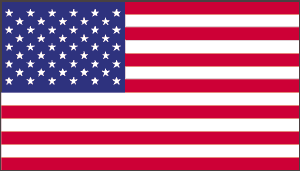
STANDARDS OF RESPECT
The flag code taken from--- "United States Code Title 36, Chapter 10"
The Flag Code, which formalizes and unifies the traditional ways in
which we give respect to the flag, also contains specific instructions
on how the flag is not to be used. They are:
- The flag should never be dipped to any person or thing.
- It is flown upside down only as a distress signal.
- The flag should not be used as a drapery, or for covering a
speakers desk, draping a platform, or for any decoration in general.
Bunting of blue, white and red stripes is available for these purposes.
The blue stripe of the bunting should be on the top.
- The flag should never be used for any advertising purpose.
- It should not be embroidered, printed or otherwise impressed on
such articles as cushions, handkerchiefs, napkins, boxes, or anything
intended to be discarded after temporary use. Advertising signs should
not be attached to the staff or halyard
- The flag should not be used as part of a costume or athletic
uniform, except that a flag patch may be used on the uniform of
military personnel, fireman, policeman and members of patriotic
organizations.
- The flag should never have placed on it, or attached to it, any
mark, insignia, letter, word, number, figure, or drawing of any kind.
- The flag should never be used as a receptacle for receiving, holding, carrying, or delivering anything.
- When the flag is lowered, no part of it should touch the ground or
any other object; it should be received by waiting hands and arms.
- To store the flag it should be folded neatly and ceremoniously.
- The flag should be cleaned and mended when necessary.
- When a flag is so worn it is no longer fit to serve as a symbol of
our country, it should be destroyed by burning in a dignified manner.
Note: Most American Legion Posts regularly conduct a
dignified flag burning ceremony, often on Flag Day, June 14th.
Many Cub Scout Packs, Boy Scout Troops, and Girl Scout Troops
retire flags regularly as well. Contact your local American
Legion Hall or Scout Troop to inquire about the availability of this
service.
DISPLAYING THE FLAG OUTDOORS
- When the flag is displayed from a staff projecting from a window,
balcony, or a building, the union should be at the peak of the staff
unless the flag is at half staff.
- When it is displayed from the same flagpole with another flag - of
a state, community, society or Scout unit - the flag of the United
States must always be at the top except that the church pennant may be
flown above the flag during church services for Navy personnel when
conducted by a Naval chaplain on a ship at sea.
- When the flag is displayed over a street, it should be hung
vertically, with the union to the north or east. If the flag is
suspended over a sidewalk, the flag's union should be farthest from the
building.
- When flown with flags of states, communities, or societies on
separate flag poles which are of the same height and in a straight
line, the flag of the United States is always placed in the position of
honor - to its own right.
- The other flags may be smaller but none may be larger.
- No other flag ever should be placed above it.
- The flag of the United States is always the first flag raised and the last to be lowered.
- When flown with the national banner of other countries, each flag
must be displayed from a separate pole of the same height. Each flag
should be the same size. They should be raised and lowered
simultaneously. The flag of one nation may not be displayed above that
of another nation.
RAISING AND LOWERING THE FLAG
- The flag should be raised briskly and lowered slowly and
ceremoniously. Ordinarily it should be displayed only between sunrise
and sunset. It should be illuminated if displayed at night.
- The flag of the United States of America is saluted as it is
hoisted and lowered. The salute is held until the flag is unsnapped
from the halyard or through the last note of music, whichever is the
longest.
DISPLAYING THE FLAG INDOORS
- When on display, the flag is accorded the place of honor, always
positioned to its own right. Place it to the right of the speaker or
staging area or sanctuary. Other flags should be to the left.
- The flag of the United States of America should be at the center
and at the highest point of the group when a number of flags of states,
localities, or societies are grouped for display.
- When one flag is used with the flag of the United States of America
and the staffs are crossed, the flag of the United States is placed on
its own right with its staff in front of the other flag.
- When displaying the flag against a wall, vertically or
horizontally, the flag's union (stars) should be at the top, to the
flag's own right, and to the observer's left.
PARADING AND SALUTING THE FLAG
Parading
- When carried in a procession, the flag should be to the right of the marchers.
- When other flags are carried, the flag of the United States may be centered in front of the others or carried to their right.
- When the flag passes in a procession, or when it is hoisted or lowered, all should face the flag and salute.
The Salute
To salute,
- All persons come to attention.
- Those in uniform give the appropriate formal salute.
- Citizens not in uniform salute by placing their right hand
over the heart and men with head cover should remove it and hold it to
left shoulder, hand over the heart.
- Members of organizations in formation salute upon command of the person in charge.
THE PLEDGE OF ALLEGIANCE AND NATIONAL ANTHEM
The Pledge of Allegiance
The Pledge of Allegiance should be rendered by standing at attention, facing the flag, and saluting.
The National Anthem
When the National Anthem is played or sung, citizens should stand at
attention and salute at the first note and hold the salute through the
last note. The salute is directed to the flag, if displayed, otherwise
to the music.
THE FLAG IN MOURNING
Half Staff
To place the flag at half staff,
- Hoist it to the peak for an instant and lower it to a position half way between the top and bottom of the staff.
- The flag is to be raised again to the peak for a moment before it is lowered.
On Memorial Day the flag is displayed at half staff until noon and at
full staff from noon to sunset. The flag is to be flown at half
staff in mourning for designated, principal government leaders and upon
presidential or gubernatorial order.
Burial
When used to cover a casket, the flag should be placed with the union
at the head and over the left shoulder. It should not be lowered into
the grave. |